Every autumn, garden centres fill up with pretty solar stakes and copper string lights, and every spring, half of them end up in the bin. Water gets in, the seals crack, the plastic goes brittle, and the whole set quietly dies. That’s the wrong way round. In the UK, choosing outdoor lighting is a technical decision before it’s a decorative one, because our weather does things to cheap fittings that a Mediterranean catalogue never had to think about. This complete guide to outdoor lighting in the UK walks through the ratings, the voltages, the placement rules and the legal bits that actually matter here, so you buy once instead of twice.
Understanding IP Ratings and UK Weather
If you only learn one thing from this article, make it the IP rating. IP stands for Ingress Protection, and it’s a two-digit code that tells you how well a fitting keeps out solid objects and water. The first digit covers dust and physical intrusion, the second covers moisture. For outdoor use in Britain, the second digit is the one that decides whether your lights see out a decade or a single damp November.
IP44 is the absolute floor for anything outside. It handles splashes and rain falling at an angle, which is fine for a sheltered porch or under a deep soffit. IP65 means dust-tight and protected against water jets, and it’s the sensible minimum for anything fully exposed: wall lanterns, bollards, path lights, garden spike spots. IP67 and IP68 go further, surviving temporary or continuous immersion, and they’re worth the extra for ground-level uplighters that sit in lawns where puddles form, or deck lights near a pond.
What people forget is that the rating describes a new, undamaged fitting. A rubber gasket that’s been baked by two summers of UV and frozen through three winters won’t seal like it did in the factory. So the practical rule is to buy one grade higher than you think you need. If a spot is going to sit in a border that gets soaked by the lawn sprinkler, don’t buy IP44 and hope. Buy IP65 and stop thinking about it.
Also look at the material. Powder-coated aluminium and stainless steel survive; untreated mild steel rusts from the inside out. Plastic housings go chalky and crack where the screw threads are. And any cable joint outdoors should be made inside a proper IP68 gel-filled connector, not wrapped in tape and buried, which is the single most common reason garden lighting fails.
Low Voltage vs Mains: What You Can Legally DIY
There are two broad systems, and the difference isn’t just brightness. It’s who’s allowed to install them.
Mains voltage lighting runs at 230V, the same as your sockets. It’s bright, it runs long cable lengths without much drop, and it’s what you’d use for a serious spread of garden spots or a large facade. But 230V outdoors is notifiable work in England and Wales under Part P of the Building Regulations, and in practice it means a competent electrician, a properly protected circuit, and a certificate. If you’re not qualified, you don’t touch the mains side. Full stop.
Low voltage systems are the DIY-friendly option, and there are two flavours people muddle together. The first is 12V or 24V extra-low-voltage, usually fed by a plug-in transformer, which is genuinely safe to handle and legal for a competent homeowner to install as a plug-and-play kit. The second is SELV, or separated extra-low voltage, which is the same idea with stricter isolation. For most gardens, a 12V or 24V transformer-fed system is the practical choice, and modern LED versions are bright enough that you won’t feel short-changed.
The catch with low voltage is voltage drop. Push too many fittings down a long run of thin cable and the ones at the far end go dim and orange. Keep runs short, use a transformer rated comfortably above your total wattage, and if you’re lighting the far end of a long garden, consider two smaller transformers rather than one big one. A 60W transformer running 45W of LEDs has headroom; the same transformer running 58W is working hard and will run warm.
A word on solar. It has improved a lot, and for a shed, a fence line or a spot you genuinely can’t cable, it’s a reasonable answer. But in a UK winter, panels get maybe two or three useful hours of weak light, and most solar fittings dim noticeably by January. If you need reliable light in December, cable it.
Placement for Safety and Atmosphere
Good garden lighting does two jobs at once: it stops you tripping, and it makes the space feel like somewhere you want to sit. The trick is to light the things you want seen and keep the source itself out of your eyeline.
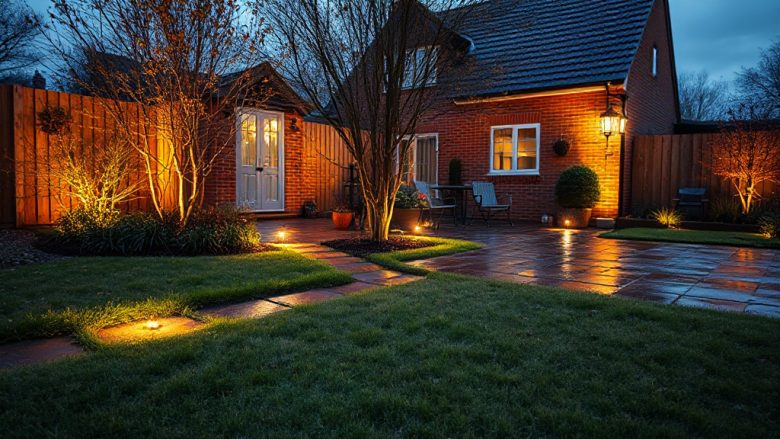
Start with the practical layer. Steps, level changes, gravel paths and the route from the back door to the bin store all need enough light to walk safely without a torch. Step lights recessed into risers, or small bollards at 400 to 600mm high, do this well. Keep them low and aimed down, so they illuminate the tread rather than shining into your face.
Then add the atmosphere layer. Uplighters at the base of a tree or a shrub throw light up through the branches and create shadows on the fence behind, which is far more interesting than a floodlight washing the whole garden. Wall lanterns flanking a door should be mounted roughly at eye height and spaced evenly, and they should throw light down and out, not straight ahead. A common mistake is buying lanterns that are too small for the wall they’re on; a lantern that looks generous in the shop looks like a postage stamp on a wide brick elevation.
Colour temperature matters more than people expect. Warm white, around 2700K to 3000K, suits brick, timber and planting and looks welcoming. Cool white, 4000K and above, reads as security or industrial, and it makes foliage look grey and sickly. For a patio, warm white is almost always the right call.
Watch out for glare and light spill. A fitting aimed at a neighbour’s bedroom window is a fast route to a complaint, and a bright light right beside a seating area kills the mood. Angle fittings away from the house, shield the source, and dim where you can. Dimmable circuits and separate switching for the practical and decorative layers let you run just the step lights when you’re letting the dog out, and everything when you’re entertaining.
Legal and Electrical Rules in the UK
This is the part people skip, and it’s the part that causes trouble.
Any new outdoor circuit should be protected by a residual current device, an RCD, which cuts the power fast if current leaks to earth. That’s a safety essential, particularly in a wet garden where a damaged cable is a real risk. Cables buried in the ground should be armoured or run in suitable ducting at a sensible depth, and they should be marked so you don’t put a fork through them next spring. Outdoor sockets need weatherproof covers and RCD protection, and they should be positioned where water can’t pool around them.
On the legal side, if you rent, get written permission before you drill into walls or run cables, because outdoor lighting counts as an alteration. If you own a listed building or live in a conservation area, external fittings and visible cable runs may need consent, and white or overly bright fittings are often refused. Check before you buy, not after.
Light pollution is also a genuine consideration. Bright, badly aimed lighting affects wildlife, particularly bats and nocturnal insects, and it can disturb neighbours. Aim fittings downward, use shields and hoods, and keep the light on your own property. Timers and motion sensors reduce how long lights are on, which is kinder to everything and cheaper to run.
Finally, if you’re doing anything on the 230V side, use a registered electrician and keep the paperwork. It matters if you sell the house, and it matters more if something goes wrong.
Maintenance Through the Seasons
Outdoor lighting isn’t fit-and-forget, but the work is small if you do it at the right times.
In autumn, before the clocks change, clean the lenses, check the gaskets and clear fallen leaves from around ground fittings. Water sitting against a seal is what kills it. Tighten any cable glands and check that joints are still above the waterline. This is also the moment to test your RCD using its test button, and to replace any bulbs or LED modules that have failed, because you’ll want everything working when the evenings close in.
Through winter, keep an eye on fittings that sit in leaf litter or snow. Don’t bury them. If a transformer is indoors or in a shed, make sure it’s ventilated and dry, and check it isn’t running hot.
In spring, trim back planting that’s grown over uplighters and spike spots, and check that cables haven’t been nicked by a spade or gnawed by wildlife. Re-aim anything that’s shifted over winter. If you’ve got solar fittings, give the panels a proper clean, because a film of grime and bird mess can halve their output.
Every few years, expect to replace gaskets and gel connectors. It’s cheap, and it’s the difference between a system that lasts fifteen years and one that fails every other winter. Buy spares when you buy the original kit if you can, because matching fittings later is often impossible.
Frequently Asked Questions
Can I install outdoor lighting myself in the UK?
You can install plug-in extra-low-voltage kits, typically 12V or 24V, as a competent homeowner. Anything running at 230V mains voltage, including new outdoor sockets and hardwired circuits, is notifiable work and should be done by a registered electrician.
What IP rating do I need for garden lights?
IP44 is the minimum for sheltered spots. For anything fully exposed to rain, use IP65 or higher, and choose IP67 or IP68 for ground-level or pond-side fittings that may sit in standing water.
Are solar garden lights any good in the UK?
They work reasonably from spring to early autumn but fade badly in winter when daylight is short and weak. For reliable year-round light, a transformer-fed low-voltage system is the better choice.
Do outdoor lights need an RCD?
Yes. Any outdoor circuit should be protected by a residual current device. Test it regularly using the test button, and have it checked if it trips repeatedly.
Get the ratings, the voltage and the placement right, and outdoor lighting stops being a seasonal gamble. Buy for the worst weather your garden gets, keep the mains side in professional hands, and light what you want to see rather than everything at once. Do that, and the same fittings will still be working when the cheap ones have long since gone to landfill.