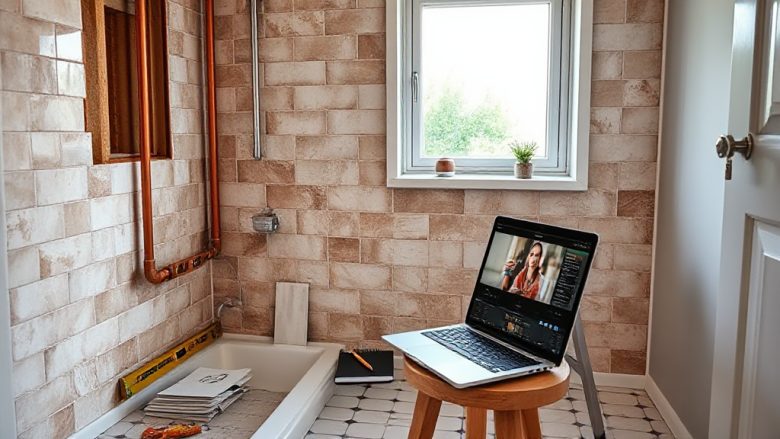
There is no single best resource for learning bathroom renovations. That’s the honest starting point. What actually exists is a handful of formats, each with a different balance of cost, feedback, and risk. If you get the format wrong, you either waste money on a course you never finish or you learn waterproofing from a stranger’s half-finished forum thread and regret it six months later. The right pick depends on how you absorb information and how much risk you’re willing to carry on the two parts of a bathroom that punish mistakes hardest: plumbing and waterproofing.
This comparison covers the four formats most first-time DIYers end up choosing between — video courses, books and manuals, forums and communities, and hands-on workshops. For each one I’ve set out what it actually teaches, what it costs, how long it takes to get useful, and who it suits. If you’re refitting a small bathroom yourself, one of these will fit you better than the others. Probably two of them, combined.
Video Courses: Best for Watching the Sequence Before You Touch Anything
Video is where most people start, and for good reason. A bathroom renovation is a sequence problem before it’s a skill problem. You need to know that the waste pipe goes in before the floor is levelled, that the tanking membrane goes on before the tiles, and that the shower valve body gets set into the wall before the board is closed up. Watching someone do it in order, at normal speed, with the camera staying on the hands, teaches that sequence faster than any written description.
What video courses teach well: stripping out, first-fix plumbing layout, board selection, tanking application, tiling around awkward cuts, silicone lines, and the order of operations from empty room to finished room. What they teach badly: anything that depends on your specific walls. A course filmed in a timber-framed stud bathroom won’t tell you what to do when you open your wall and find solid brick and old lead pipe. Video also can’t feel whether your substrate is flat. You’ll only learn that by putting a level on it.
Cost sits anywhere from free to a few hundred pounds for a structured course with downloadable plans. Free video is genuinely useful for the overview stage. Paid courses tend to be worth it only if they include a materials list and a schedule, because that’s the part beginners underestimate. Time to get useful: a weekend of watching, realistically, if you take notes on the sequence rather than just letting it play.
Who it suits: visual learners, anyone who wants to see the whole job before committing, and people renovating a bathroom that resembles the one on screen. If your bathroom is unusual — a wet room, a very small ensuite, a period property with odd pipework — video gets you 70% of the way and then leaves you.
Books and Technical Manuals: Best for the Rules You Can’t See
Books are the least glamorous format and the one most likely to save your renovation. Video shows you what a job looks like when it goes well. Books tell you the rules that decide whether it will. Building regulations on ventilation, the minimum fall on a shower waste, the required thickness of substrate behind tiles, the zones where electrical fittings are permitted near water — none of that is exciting, and all of it is the difference between a bathroom that passes inspection and one that grows mould behind the tiles.
A good DIY renovation manual will walk through first-fix and second-fix plumbing, explain how a trap works and why you need one on every waste, cover waterproofing systems in enough depth to choose between a paint-on membrane and a sheet membrane, and give you the tolerances that matter. Manufacturer installation manuals are free and often more precise than any general book — the catch is that they only cover their own product, so you need to read them alongside something broader.
Cost is low. A decent renovation manual costs about the same as a takeaway for two, and manufacturer manuals cost nothing. Time to get useful: an evening of skimming, then dipping back in at each stage. Nobody reads these cover to cover, and you shouldn’t try.
Who it suits: anyone doing plumbing or waterproofing themselves, anyone in a property where regulations are strict, and anyone who learns better from text than from a presenter. The weakness is obvious — no feedback, no demonstration, and a lot of assumptions about what you already know.
Forums and Communities: Best for the Problem You Didn’t Expect
Every renovation has a moment where the plan meets the reality of your house and stops working. The wall isn’t square. The old waste is cast iron and won’t take a modern fitting. The floor joists run the wrong way for the shower tray you bought. This is where forums and online communities earn their place, because they’re the only format built around the specific, awkward, already-happened-to-someone-else problem.
What they teach well: diagnosis. Post a photo of your pipework and someone will tell you what it is and whether you can touch it. Search an old thread and you’ll often find your exact situation, down to the make of boiler. What they teach badly: consistency. Advice quality varies enormously, and confident wrong answers exist. You’ll get three replies, two of which contradict each other, and you’ll need enough grounding from books or video to judge which is right.
Cost is nothing. Time is the hidden expense — an afternoon can vanish reading threads, and the good answers are often buried in a long argument. Treat forums as a diagnostic tool, not a curriculum. Use them when you’re stuck, not to learn the whole job.
Who it suits: anyone mid-project with a specific snag, anyone in an older property with unusual construction, and anyone who wants to sanity-check a plan before spending money on materials. If you have no baseline knowledge, forums will confuse you more than help you. Get the baseline elsewhere first.
Hands-On Workshops: Best for Skills You Can’t Learn From a Screen
Some bathroom skills are physical, and no amount of watching will transfer them. Cutting tiles cleanly around a valve. Getting a level silicone bead in one pass. Soldering a copper joint without scorching the wall behind it. Applying tanking tape into a corner so it doesn’t lift. These are hand skills, and hand skills need repetition with someone watching and correcting.
Short courses at colleges and trade training centres cover tiling, basic plumbing, and sometimes full bathroom fitting over a few days. You get real materials, real tools, and an instructor who can see what you’re doing wrong in the first thirty seconds. That feedback loop is worth more than any video for the specific skills that decide whether your finish looks professional or homemade.
Cost is the highest of the four formats — a multi-day course can run into several hundred pounds, more than a full set of tools in some cases. Time commitment is real too: a weekend minimum, often a week for a proper fitting course. But the return is proportional. People who take a tiling course tend to tile their whole bathroom in a weekend instead of three weekends of frustration.
Who it suits: anyone planning to do their own tiling, anyone nervous about plumbing joints, and anyone who has tried to learn a hand skill from video and found it doesn’t stick. If you’re paying a tiler anyway, a course is harder to justify. If you’re doing the tiling yourself, it pays for itself on the first wall.
How to Combine These Without Overwhelming Yourself
The mistake is treating these as alternatives. They’re stages. Start with a structured video course to learn the sequence and see the whole job end to end. Add one renovation manual for the regulatory and technical rules, and keep the relevant manufacturer manuals to hand for the products you actually buy. Use forums only when you hit something specific and unexpected — not as your main source. Then, if any part of the job is a hand skill you’ve never done, take a short course before you start rather than after you’ve ruined a box of tiles.
That combination covers sequence, rules, diagnosis, and technique. It also keeps the spend sensible: free video, a cheap book, free forum help, and one paid course aimed at the skill you’re least confident about. Nobody needs all four at full depth. You need enough of each to get through your own bathroom safely.
If you want a single starting point: video first for the overview, book second for the rules, and a workshop only for the one skill you genuinely can’t teach yourself. Forums fill the gaps when your house turns out to be stranger than the course assumed. Pick the format that matches your risk on plumbing and waterproofing — those are the two places where learning from the wrong resource costs the most to fix.