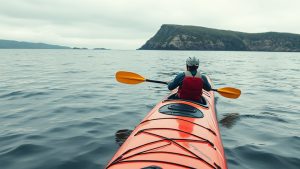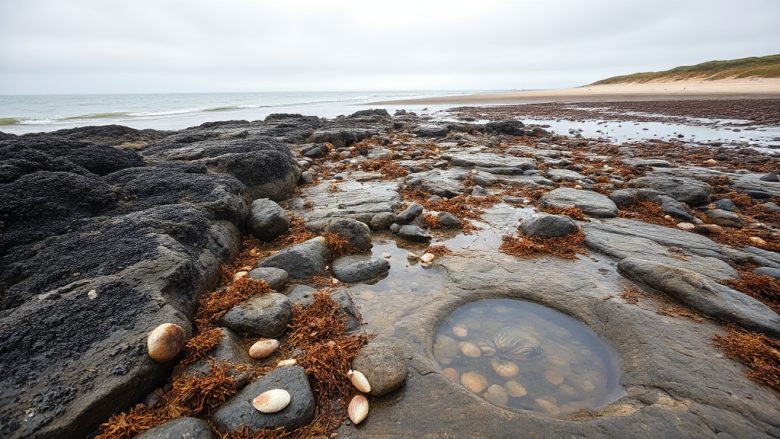
You step onto the path and the air changes before the view does. Salt, iodine, cold stone. Gulls somewhere above, waves doing that patient thing they do against rock. You stop at the edge of a headland and look down at the shore, and it all reads as one big texture: water, stone, sand, green stuff, birds. But a coast isn’t one thing. It’s a handful of different living systems stitched together, and each one has its own rules about who lives there and why. Once you can tell them apart, a coastal walk stops being scenery and starts being a story you can follow. This beginner guide to coastal ecosystems is meant to be that translation layer, a simple map you can carry in your head.
Rocky Shores and Tide Pools
Rocky shores are the easiest coastal ecosystem to fall in love with, because everything is visible. The tide does the work of a slow elevator, lifting and dropping the water line twice a day, and the animals arrange themselves in bands according to how much exposure they can survive. That banding has a name, zonation, and once you notice it you can’t stop noticing it.
At the top of the shore, in the splash zone, you’ll find lichens, tiny periwinkles, and the tough black tar lichen that looks like someone spilled ink on the rock. A little lower, barnacles and limpets dominate, packed so tightly they look like a single crust. Lower still, the brown seaweeds take over, then the reds, and finally the kelp and the animals that can’t handle being dry at all: sea anemones, starfish, crabs, small fish trapped in pools until the water returns.
Tide pools are the highlight for most beginners, and for good reason. They’re miniature worlds with a clear boundary. A pool high on the shore might be hot, salty, and low on oxygen by late afternoon. A pool near the low-water mark stays cold and stable and holds far more life. Look for the green beadlet anemone, the common limpet, the dog whelk, and the little chitons clamped to the underside of stones. If you see a starfish, resist the urge to lift it out. They’re more fragile than they look, and even a brief exposure to air can stress them.
The thing that surprises people most is how much of the rock is alive. That rough pinkish crust on a boulder is a coralline alga, not stone. The chalky white rings are barnacle plates. The rock is a living surface, and you’re walking on it.
Sandy Beaches and Dunes
Sandy beaches look emptier than rocky shores, which is exactly why they’re worth a slower look. The sand itself is a habitat. Between the grains live meiofauna, tiny animals measured in fractions of a millimetre, and they support a whole food chain that runs from worms up to wading birds. When you see a flock of oystercatchers or sanderlings working the wet sand at the tide line, they’re feeding on that invisible layer.
The strandline, that dark ribbon of debris at the top of the beach, is one of the richest micro-habitats on the coast. Seaweed, cuttlebone, mermaid’s purses, driftwood, and the occasional dead jellyfish all break down there and feed sand hoppers, which in turn feed birds. It looks like litter. It isn’t. Leave it alone.
Behind the beach, dunes are a coastal ecosystem built by plants. Marram grass is the engineer here, sending roots down to hold loose sand in place. Sea couch, sand sedge, and sea holly follow. The further inland you go, the more stable the dune becomes, until you reach dune grassland and eventually dune scrub, often with willow or sea buckthorn. Each zone has different plants because each zone has different wind, salt, and water conditions.
Dunes are also the most easily damaged coastal habitat for a beginner to walk through. A single footstep through marram grass can start a blowout, a patch of bare sand that the wind then enlarges. Stick to the paths, even when the path is a bit longer. The dune is holding the beach in place.
Estuaries and Salt Marshes
Where a river meets the sea, you get an estuary, and estuaries are the most productive coastal ecosystems on the planet per square metre. Fresh water and salt water mix, nutrients arrive from upstream, and the result is a nursery. Juvenile fish, crabs, and shrimp use estuaries as a safe growing ground before heading out to open water. If you’ve ever wondered where the fish you see in a harbour came from, the answer is often an estuary a few miles up the coast.
Salt marshes form along the sheltered edges of estuaries, where fine sediment settles and plants like cordgrass and glasswort take hold. These plants are halophytes, meaning they tolerate salt, and they do it by pumping salt out through their leaves or storing it in their tissues. The marsh builds itself upward, layer by layer, trapping sediment with every tide. Over decades, a marsh can grow tall enough to become dry land.
Salt marshes are also serious carbon stores. The mud beneath them locks away organic matter for centuries, which is one reason they matter far beyond their size. They’re also a natural flood defence, absorbing wave energy before it reaches whatever is behind them.
For a beginner, the best way to explore an estuary is from a path along the top of the marsh or from a viewpoint over the mudflats. Mud is not a surface to walk on. It’s a habitat, and it’s also genuinely dangerous in places. Watch the birds instead: curlew, redshank, shelduck, and in winter, huge flocks of waders that arrive from the Arctic. The tide moves fast in estuaries. Check a tide table before you go anywhere near the water’s edge.
How to Observe Without Disturbing
The single most useful habit you can build is to slow down and stop moving. Most coastal animals react to shadow and vibration, not to being looked at. Stand still for two or three minutes at the edge of a pool and things will reappear: crabs creeping out from under ledges, blennies darting across the bottom, anemones opening their tentacles again.
A few practical rules will keep your visit low-impact.
- Turn stones back exactly as you found them. The underside is a habitat; flipping a rock and leaving it exposed kills the community that was living in the dark.
- Don’t take shells, seaweed, or empty crab shells home. They’re part of the beach’s nutrient cycle, and the strandline is a habitat, not a souvenir shop.
- Keep your distance from seals, seabirds on nests, and anything with young. If an animal changes its behaviour because of you, you’re too close.
- Stay off dunes, salt marsh, and mudflats unless there’s a marked path. These surfaces are more fragile than they look.
- Use a phone torch sparingly in pools. Light stress adds up, especially at night.
- Take everything you brought. Litter on a strandline is easy to mistake for food by the animals that live there.
There’s also a timing trick worth knowing. The best window for tide pool exploration is the two hours either side of low tide, and the best low tides of the month are the spring tides, which happen roughly every two weeks around the new and full moon. A spring low exposes parts of the shore you’ll never see otherwise. Check a local tide table, and always start your walk on a falling tide so the water is moving away from you, not toward you.
A Simple Field Notebook Method
You don’t need a biology degree to get good at this. You need a notebook and a habit. The method is simple: for every stop, write down five things in the same order every time. Location, tide state, substrate, three species you can name, and one question you can’t answer yet.
Location is just where you are, roughly. Tide state is whether the water is high, low, rising, or falling, and roughly how far up the shore you are. Substrate is what you’re standing on: rock, sand, mud, shingle, or a mix. The three species are your identification practice. They can be as broad as “brown seaweed,” “small black snail,” and “white barnacle” at first. Precision comes later. The unanswered question is the important one. It’s what turns a walk into a reason to come back.
Sketching helps more than you’d expect. A rough outline of a pool with the animals marked where you saw them will teach you more about zonation than any diagram. Photographs are useful too, but a photo of a limpet on a rock tells you almost nothing. A note that says “limpet, mid-shore, on vertical rock face, dry at 14:20” tells you a lot.
Over a season, your notebook becomes a record of how the shore changes. You’ll start to see patterns: which pools hold water through the summer, where the first seaweeds appear in spring, which birds show up in October and disappear in March. That’s the point where you stop being a visitor and start being a regular.
Frequently Asked Questions About Coastal Ecosystems
What is the easiest coastal ecosystem to start learning?
Rocky shores, without question. The animals are visible, the zonation is obvious once you know to look for it, and you can explore a small area in half an hour. Sandy beaches are simpler to walk but harder to read, because most of the life is hidden under the surface.
Is it safe to touch animals in a tide pool?
Generally, no. Most pool animals are stressed by handling, and some, like sea anemones, can be damaged by the oils on your skin. Look, don’t touch. If you must move something to see underneath it, use a wet finger or a small flat stone, and put it back exactly where you found it.
Why do estuaries matter so much for wildlife?
They’re nurseries. The mix of fresh and salt water, the shelter from waves, and the supply of nutrients from the river make estuaries ideal for young fish and invertebrates. Many commercial fish species depend on estuaries for at least part of their life cycle, which is one reason these habitats are protected in many places.
How do I know if I’m looking at a salt marsh or just muddy ground?
Look for the plants. Salt marshes are defined by salt-tolerant vegetation, especially cordgrass, glasswort, and sea aster. Bare mud with no plants is a mudflat, which is a different habitat with its own community of worms, snails, and birds. Both are worth watching, and both are best observed from a distance.
None of this requires equipment or expertise. It requires attention. Next time you’re on the coast, pick one spot, sit with it for twenty minutes, and write down what you see. The coast will do the rest.